
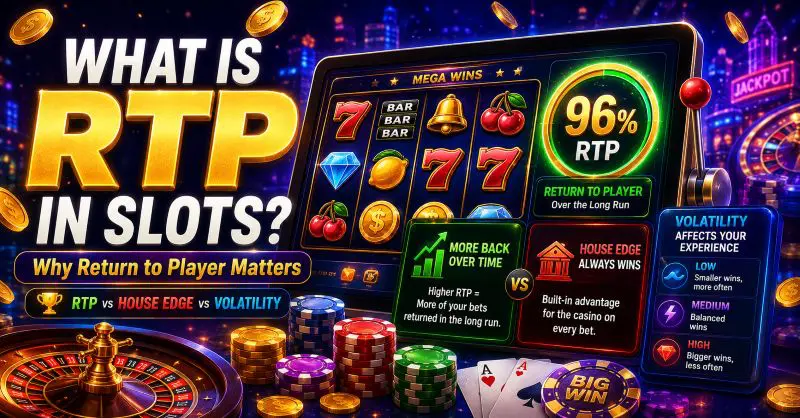
It’s simple to understand what return to player (RTP) means in slot games. In basic terms, RTP shows the average Percentage of all funds staked on a slot that will be returned to players over the long term. Take a game with a 96% RTP. Essentially, of every 100 units placed on the game throughout its lifespan, approximately 96 units will return to players as winnings and 4 units will remain with the Casino. Those four percent represent the house edge. The house edge and RTP are simply two sides of the same coin – if you know one, you automatically know the other. What gets people confused is that this is a theoretical, long-run average and not a guarantee about your Tuesday evening gaming session. It is based upon millions of simulated spins, not the forty spins you played during your lunch break.
What Does RTP Actually Mean in Slots?
Slot machine studios & testing labs calculate the theoretical return for a slot game prior to release. These tests involve simulating enormous amounts of spins, often hundreds of millions. Each successful spin is added to a total sum along with each possible winning combination multiplied by its probability. Then the total expected payouts are divided by the total bets made. As a result, a fixed number is created within the slot game’s programming code. This number is validated by third-party auditors such as eCOGRA or iTech Labs. Therefore, it remains constant and is unaffected by factors such as the time of day, length of playtime, or if you switch from betting $1 per spin to $5 per spin.
How That Percentage Gets Calculated
There is a nuance worth mentioning: some Slots provide different RTP values based on whether you activate a specific bonus mode or bet feature. Although a game may display a base RTP of 96%, it may indicate an RTP of 95.4% if you purchase the bonus round, because purchasing the bonus round alters the mathematical probability behind it. Always examine whether the title provides multiple RTP ratings in its paytable as well as whether an operator allows developers to release various RTP versions of the same slot game. Sometimes, players unknowingly choose to play a lower RTP version of a slot due to their inattention.
As mentioned earlier, understanding RTP is vital for making informed decisions regarding choosing slot games. There is a significant difference between a 92% RTP slot game and a 97% RTP slot game. At a 92% RTP, for example, you would theoretically lose 8 cents of every 10 dollars wagered. Conversely, at a 97% RTP, you would only lose 3 cents of every ten dollars. The house edge is essentially doubled, and compounding occurs with prolonged gameplay. If you are someone who frequently plays Slots versus doing so only sporadically, RTP should become an important factor in determining which slot games you select, just as evaluating the expense ratio of a mutual fund would be before investing.
I’ve seen many players pursue flashier graphics and licensed themes (e.g., Egyptian pyramids or superhero tie-ins), while completely disregarding that the adjacent game has a two-point higher RTP and virtually identical gameplay.
Why RTP Matters More Than Most Players Realize
Understanding both RTP and Volatility is crucial in slot selection. Volatility, otherwise known as variance, refers to the manner in which a slot distributes its winnings. An extremely low Volatility slot game with a 95% RTP could potentially generate dozens of smaller winning combinations on consecutive spins while maintaining stability in your account balance. A high Volatility slot game with the same 95% RTP could remain dormant for 200 + spins and then suddenly produce a single large winning combination that accounts for a substantial portion of that theoretical return. Despite having the same RTP, both experiences are vastly dissimilar.
Hit frequency, often referred to as winning frequency, represents how often a player wins anything at all regardless of winning amount. While it’s easy to misunderstand this as being related to RTP, they are measuring different aspects. Would anyone assume that win rate equals RTP? Not even close. A slot could potentially have a 40% hit frequency (good hit frequency) yet still contain a poor 93% RTP, since most of those wins were quite small. Conversely, a slot with a poor hit frequency of 20% can have an impressive 97% RTP if the less-frequent larger wins compensate accordingly.
Land-based slot games vs online slot games
While there are certainly some exceptions, the overall RTP found in land-based games compared to online games is significantly different. Online slot games typically operate between 94% and 98%, and regulated markets require operators to list these figures either on their website or in-game somewhere. Land-based Machines located near Casino entrances or in airports typically operate in the range of 85% to 92%, since land-based Machines have additional costs (real estate, maintenance, etc.) that need to be offset through tighter mathematics.
While there are certainly some examples where land-based venues have advertised slot games with RTPs greater than 97%, as an overall trend, land-based Machines typically have lower RTP percentages compared to online slot Machines. Therefore, if you strictly optimize for long-term profitability, online Slots will likely yield better results than their land-based counterparts.
Finding the actual RTP value
Fortunately, finding the RTP value for a slot game requires very little effort and knowledge. Unfortunately, most operators do not place this information prominently on their websites. Several places to find the RTP value include:
- Clicking on the i/info button inside the slot game screen itself (usually in the top-right corner). Doing so opens the paytable and rules.
2. Visiting the official website of your slot game provider (many slot providers post their games’ RTP values on each game’s individual webpage).
3. Checking independent slot databases and review websites that compile verified RTP values for thousands of titles.
4. Examining your Casino’s help or fairness section (regulated casinos are normally required to list RTP ranges for each of their titles).
5. Contact support chat directly and request the information (licensed casinos are usually obligated to have access to this type of information).
Myths regarding RTP
Unfortunately, numerous Myths and misconceptions surrounding RTP continue to exist. However, several common ones deserve clarification for the purposes of assisting readers in making better-informed decisions regarding selecting slot games.
Higher RTP does not mean guaranteed winnings per session
Is higher RTP = greater chances of winning more money today? No… This is fundamentally a long-term question vs. a short-term question.
RTP has nothing to do with how “due” a machine is; there is no memory in slot mathematics and no game owes you money because you’ve been unlucky.
Changing your wager size will change your exposure but will not change the RTP Percentage.
A high RTP game is not necessarily more “fair” than a low RTP game; both have house edges; One just has a smaller one.
RTP figures are based upon theoretical average returns across millions of simulations; not promises about any hour of gaming.
Some Judgment calls from somebody that tracks this Stuff
After studying and reviewing numerous paytables and comparing thousands of slot games, i personally believe that using RTP as a filtering tool is fine but not a crystal ball. Anything under 94% I’ll pass unless I’m able to justify paying more house edge for entertainment reasons only. Between 96% and 98%, I cease caring about exactly .01 decimal variations and begin looking at Volatility as it affects my experience much more than half of a Percentage point of theoretical return.
And finally… I’ll never be swayed by a large single win to believe a low-RTP game is secretly generous; recency bias talking, not math.
Questions frequently asked – answered quickly
What does RTP mean in Slots? – summed up in one sentence:
It represents the theoretical Percentage of funds returned to players after playing millions of spins.
Will changing my bet amount change my RTP?
No. The Percentage remains constant regardless of stake. Note: some games do offer different published RTP values for bonus-buy features.
Are bonus rounds considered when calculating RTP?
Yes and no, respectively. Bonus buy options in particular often carry slightly different published RTP percentages than their base game counterpart.
What is a good RTP percent?
Most players feel that anything above 96% is solid, with anything above 97% being exceptional according to industry standards.
Can you explain the difference between RTP and variance?
RTP shows how much money comes back over time, while variance describes how bumpy or smooth the ride was getting there.
Why should smart slot gamers care about RTP?
Simply put, because over enough spins, a couple of Percentage points can make a meaningful difference in terms of dollars remaining in your pocket and that’s worth knowing before you pick which slot game to play versus after you already picked it and lost money!