
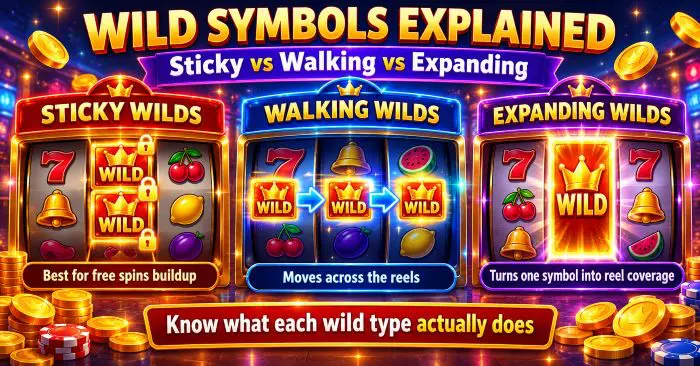
Most people find out about wilds the same way. You run a game; you hit a strange symbol; three cherries turn into a winning combination and you say “that’s the joker.” You then pull up a different slot machine and the wild does something entirely different. It grows. It moves One reel to the left. It sits there for ten spins while everything else around it is spinning. The joker has learned some tricks. This guide explains those tricks. Sticky wilds, walking wilds and expanding wilds are the three behaviors you will encounter most often in modern online slots, and they each affect how often a game pays and how much a game pays, as well as how a game feels to play. Once you know how each wild behaves, the pay table will stop reading like fine print in a contract and start showing you what kind of ride you’re getting.
What are wild symbols?
Wild symbols are substitutes. They replace other symbols to create winning combinations based on the number of paylines, ways to win, or clusters, depending on how your game creates wins. For example, if a line says cherry, cherry, wild, cherry, the wild becomes a cherry and you receive payment for four. That’s really all the job is. Plenty of slot machines do no more. Net entertainment’s Gonzo’s quest is an excellent example. The wild in Gonzo’s quest is simply a substitute. The game receives its excitement from the Avalanche feature in which winning symbols blow away (explode) and new symbols fall into the spots.
With every consecutive win during Free Falls, the multiplier increases. Two things to know immediately: wilds almost never substitute for scatter/bonus symbols since those initiate features and the game developer wants total control over how often that occurs. Also, some wilds are payers. 5 wilds on a line can be the highest-paying prize in a game. And, in some older games the wild pays more than any other paying symbol.
Everything else here is about what happens when designers make the wild do something different than just sit there.
Sticky wilds: locked symbols which build value over time

What are sticky wilds?
A sticky wild lands and then remains in the same reel position longer than one spin. All the other symbols continue to rotate around it while it continues to substitute during every spin it is present for. You’ll also see them called locked wilds, locking wild symbols or persistent wilds. Same idea. The length of time the sticky wild stays is really the only variable, but it changes from game to game.
How do sticky wilds work in free spins rounds?
This is where sticky wilds earn their reputation. Picture a free spins round of ten or twelve spins. On the Second spin a wild lands on reel three and it stays. On the fifth spin another wild lands on reel four and it stays too. By the ninth spin you may have Five or six sticky wilds locked on the grid, so as you hit your remaining spins, you are essentially playing partially pre-filled board.
The value compounds. Wilds that land earlier in the bonus are worth much more than those that land later because they get more spins to contribute to. A wild landing on the first spin of a twelve-spin round works for twelve spins. A wild landing on the twelfth spin works for One.
Sticky wilds in respins
The other common format is the sticky wild respin. A wild lands, locks and the game gives you a free respin with the wild held in place. If another wild lands, it also locks and you receive another respin. Starburst uses this method, though it does expand when a wild lands as well. We will return to that later. Dog house by pragmatic play is another good reference point. In the base game its wilds appear on the middle three reels and carry either 2x or 3x multipliers. In free spins these wilds become sticky for the rest of the round so each One you land keeps contributing its multiplier to every win it touches.
When multiple wilds share a winning line they add together their multipliers which creates where large wins come from. Based upon years of experience watching players play games like this — sticky wild bonuses are emotionally front-loaded. You know within several spins whether a round has legs. A bonus without anything sticking early never recovers and players who understand that tend to set realistic expectations rather than waiting hopesefully at spin eleven.
Walking wilds: moving symbols, respins & shifting wins
What are walking wilds?
A walking wild lands and then moves one position per subsequent spin, usually awarded a free respin as well, until it walks off the edge of the grid. You’ll find examples using the same mechanic called moving wilds, shifting wilds or roaming wilds though roaming sometimes refers to wilds that move in random directions rather than One fixed step.
How do walking wilds work?
Think of it as a chain. Wild lands on reel four. Respin. Now it is on reel three still substituting. If another wild lands somewhere during that respin, then now two wilds are walking. Respin again. Both move left One step again. The chain continues until there are no more wilds on the grid. Jack and the Beanstalk, released by NetEnt in 2011, was the first game to popularize walking wilds.
In the base game each wild that lands walks One reel to the left with a free respin each step. The free spins round adds treasure collection to the mix: collect key symbols during the bonus round to upgrade the walking wild into stacked walking wilds, so instead of a single wild crossing the entire grid, you get towers of positions sliding across it. Collecting keys early in the round makes a difference between a forgetful bonus and memorable One.
Walking wild respins: what they actually give you.
The appeal of walking wilds is spread out rather than concentrated. A sticky wild holds One spot and hits the same paylines over and over again. A walking wild visits multiple reel positions and hits different paylines each time. On a twenty-line machine, that means a lot of variety in which lines it helps complete. The trade-off is reach.
A wild landing on reel one in a left-walking game has nowhere to go, therefore giving you only one shot and leaving after that. A wild landing on reel Five can give you the whole trip. Positional luck plays a larger role than people think and that’s why walking wild machines typically produce a ton of small-medium wins instead of huge stacked outcomes that sticky wild bonus rounds produce.
Expanding wilds: One symbol that can cover a full reel
What are expanding wilds?
An expanding wild lands on a single position and then grows to cover more of the grid most commonly the entire reel it landed on. An example would be a wild landing in the center row of reel three becoming a full reel of wilds top to bottom. Some games expand across rows instead, and some even expand blocks of Two, three or more positions.
Expanding wilds on middle reels
You will notice that most expanding wild slot games restrict their expanding wilds to reels two, three, and four. There is a reason for this. Most slots pay left-to-right on adjacent reels starting from reel One. A wild reel on reel One doesn’t help much since you still need matching symbols on reels Two and three for a match. An expanding wild located in the middle connects symbols on both sides which is where it does the most work.
Starburst is the ultimate example here. Its expanding wilids can only land on reels Two, three and four. When an expanding wild lands it fills that entire reel, locks into place and triggers a respin. If another expanding wild lands during that respin, it also fills that entire reel and locks, triggering another respin up to maximum of three.
Best slots for sticky, walking, and expanding wilds
Rather than a giant ranking, here are some of the best games I’d recommend to anyone looking to feel how each mechanic performs.
Best slots with sticky wilds
Dead or Alive is probably the purest sticky wild experience out there. Nine paylines, sticky wilids remain throughout the entire free spins round, 2x multiplier and very high volatility. Old school simple stuff, but exactly why sticky wilds are exciting and frustrating at once. If you want more options, dead or alive, 2 offers three flavors of sticky wild bonus in one game. Dog House is a friendlier alternative with sticky multiplier wilds in free spins on a more modern design.
Best slots with walking wilds
Jack and the Beanstalk remains the benchmark for this type of behavior. Walking wilids with respins in base game and stacked walking wilids upgraded with treasures collected during bonus round create better readability for learning new releases.
Best slots with expanding wilds
Starburst is obvious choice and still provides clear explanation of expanding wilids anywhere online. Wilids on middle three reels fill an entire reel expansion, sticky respins up to three times and pays both ways for wins. Low volatility makes it ideal for seeing mechanics in action without long dry spells.
Honorable mentions:
Immortal Romance should be played simply for the Wild Desire feature alone plus variability of its four free spins modes.
Frequently asked questions about wild symbols
What is the main difference between sticky, walking, and expanding wilds?
A sticky wilid remains stationary in One position for multiple spins. A walking wilid moves One position per spin generally providing additional respins along way until it leaves grid completely behind it. An expanding wilid grows to cover more space on grid such as an entire reel or section based upon game rules most often found in combination form.
Do sticky wilids stay through entire free spins round?
Maybe sometimes in games like dead or alive they do. In other cases they last through set number of spins or only during series of respins sequence provided in rules section pay table tells you which.
Do walking wilds provide respins?
Yes in majority of walking wilid games they do. Each step provides additional free respin(s), so a wilid landing on farthest end can generate multiple extra spins as it crosses grid area as well as requires confirmation in rules as few games move wilids only between paid spins.
Do expanding wilids always cover entire reel?
Generally yes but not always most frequently fill entire reel however some games expand across rows, blocks or partially check description of feature to determine exact extent of expansion.
Are wilids almost always substitutes?
Almost always regular paying symbols; however, they are excluded from scatters & bonus symbols. Most games include some exceptions, although some games use wildcards as scatters themselves, similar to Book of Dead.
Do wilids pay separately?
Many games: yes; 5 wilds on a line could be among the highest-paying prizes available in the game, while many modern games don’t offer separate payment at all, listed either way in the pay table.
Do wilds increase RTP or volatility?
No, not added to published RTP; it already includes all features and shapes volatility — bonus rounds featuring sticky/wild/multiplier tend to push volatility upward, while base game/feature-based expanding/walking tends to smooth volatility downward.
How do I know how a specific wilid works in my favorite slot?
Read rules of the feature described under info/help screen of slot machine — not values of symbols — words used describe what the game actually does, regardless of what the promotional banner calls it.